
The USA F-1 Student visa is the most common student visa for international students who want to study in the United States. The USA Student Visa allow students to pursue full-time at approved institutions such as universities, colleges, high schools, and language training programs. Many students choose the USA each year from around the world choose the USA for its high-quality education, global exposure, and strong career opportunities.
With a USA F1 Student Visa students can work part-time on campus during their studies and apply for Optional Practical Training (OPT) after graduation to gain work experience. understand the eligibility requirements, required documents, application steps, and visa interview process is important for a smooth and successful USA Student Visa application.
The USA F1 Student Visa is a non-immigrant student visa that allows international students in the United States at -approved institutions. The USA F1 Student Visa is required for students who plan to study full-time at universities, colleges, high schools, language training institutes, or other academic programs approved by the U.S. government.
The main purpose of the USA F-1 student visa is to allow students to complete their education in the U.S. and return to their home country after finishing their course. The length of stay depends on the course length mentioned on the Form I-20, which is issued by the educational institution, along with any authorized training period.
The United States mainly offers different types of student visas for international students.
F-1 Visa:
This visa is for academic studies such as universities, colleges, and English language programs. F-1 students can work part-time on campus during their studies and may apply for Optional Practical Training (OPT) after completing their course
J-1 Visa:
The J-1 visa is for exchange programs such as students, researchers, interns, and trainees. It is usually sponsored by a government or an approved exchange organization. J-1 visa holders can work only if the job is part of their exchange program. Some J-1 students must return to their home country for two years after completing their program.
Important Note:
Tourist visas (B-1/B-2) or visa-free entry programs cannot be used for study purposes. Students must apply for the correct student visa to study legally in the United States.
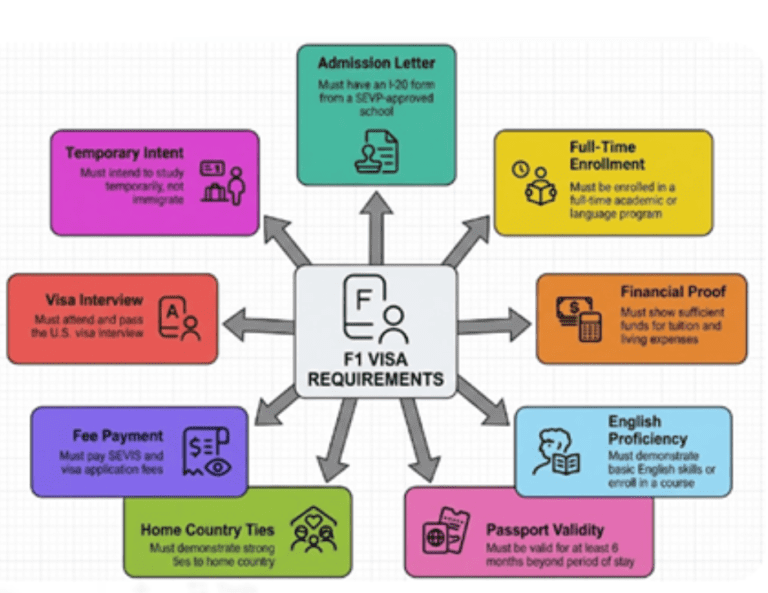
To apply for an F-1 student visa, applicants must meet the following requirements:
You must have an admission letter (Form I-20) from a S. school approved by Student and Exchange Visitor Program (SEVP).
You must study full-time in a university, college, or English language course
You must provide proof of sufficient financial funds to cover tuition fees, living expenses, and other study-related costs during your stay in the U.S.
You must have basic English skills or be enrolled in an English language training program
Your passport must be valid for at least six months beyond your intended stay in the United States.
You must prove that you intend to return to your home country after completing your studies.
You must also pay the Student and Exchange Visitor Information System (SEVIS) fee and visa application fee, attend the U.S. visa interview, and clearly explain that your purpose is only to study, not to stay permanently in the United States.
Get admission from a SEVP-approved U.S. school and receive Form I-20
Check and sign your I-20
Pay the SEVIS I-901 fee online
Complete the DS-160 visa application form
Book your visa interview at the U.S. Embassy or Consulate
Prepare required documents (passport, I-20, finances, academics)
Attend the visa interview and explain your study plans
Wait for the visa decision and collect your passport with the visa once it is approved
Travel to the U.S. up to 30 days before your course starts
There is lot of technical job to apply for visa. If you do not want to take the chances with your visa and miss your goal take professional help like Global Gateways who are serving since more than 28 years with high commitment.
Students applying for an USA student visa must submit their application through a U.S. Embassy or Consulate in their country of residence. While the application forms are completed online, the visa interview must be attended in person. During consular interview huge number of students visas are refused. To increase the chances of getting the visa approach Global Gateways.
Once you receive your Form I-20 from a SEVP-approved U.S. institution, follow these steps carefully:
After receiving your I-20, you must pay the SEVIS I-901 fee to activate your student record.
The DS-160 is the official U.S. non-immigrant visa application form.
After submitting the DS-160 form, book your visa interview appointment at the nearest U.S. Embassy or Consulate.
Attend the visa interview with all required documents:
Passport (valid for at least 6 months beyond your stay)
Form I-20 (signed)
DS-160 confirmation page
SEVIS fee payment receipt
Visa application fee receipt
Academic certificates and financial proof
The F-1 visa allows international students to study in the United States for the full duration of their academic program. While the visa stamp may be valid for several years, your actual stay in the U.S. depends on the program length listed on your Form I-20. As long as you study full-time, follow visa rules, and keep your I-20 active, you can legally remain in the U.S. under Duration of Status.
After completing your course, you are given a 60-day grace period to prepare for departure, transfer to another program, or apply for work authorization. Even if your visa stamp expires during your studies, you can stay legally as long as your student status remains valid. Eligible students may also apply for Optional Practical Training (OPT), which allows up to 12 months of work, or up to 36 months for STEM graduates.
Planning your F-1 visa application early is essential for a smooth study abroad journey. Students can apply for a U.S. USA student visa up to 365 days before their program start date, but they are allowed to enter the U.S. only 30 days before classes begin.
University & Course Guidance: Expert advice on choosing the right U.S. university and program.
F-1 Visa Application Support: Step-by-step assistance with all required documents.
SEVIS Fee & DS-160 Assistance: Guidance for fee payment and correct form submission.
Mock Visa Interviews: Practice sessions to boost confidence to attended the Consular interview.
Financial Documentation Support: Help with proof of funds and other financial requirements.
Visa Appointment Scheduling: Assistance in booking appointments and interview preparation.
End-to-End Support: Complete guidance from application submission.
You can apply for your F-1 visa up to 120 days before your program start date. However, you cannot enter the US more than 30 days before your program begins.
You can work on-campus up to 20 hours/week during school and full-time during breaks. Off-campus work requires authorization through Common Proficiency Test (CPT) or Optional Practical Training (OPT)programs.
Yes, your spouse and unmarried children under 21 can apply for dependent visa, F1student visa dependent holders cannot work but children can attend school.
The answer would be no. However, the students can work part time on the college campus while their academic term is in session. These work opportunities include library monitor, tutor, teaching assistant. The maximum work limit is 20 hours per week. In exceptional cases, the students can work off-campus with the approval of the university officials.

Visitor Visa –To meet your Friends & Relatives:
Australia | Canada | New Zealand | USA | USA B2 | UK | Europe | Germany | Schengen countries | Netherland | Austria | Italy
Dependent Visa –for your Spouses, Children, Parents, Short term, Long term:
Australia | Canada | New Zealand | USA | UK – Tier 2 Dependents | Germany | Schengen
Business Visa –To attend conferences, Intra company transfer, Short term, Long term:
Australia | Canada | New Zealand| USA| USA B1 | UK |Schengen countries
Immigration Visa – to work and settle:
Australia | Australia 189 Visa | Australia 190 Visa | Canada | Canada PNP | New Zealand | Germany
Work Visa – Short term, Long term:
Australia | Canada | Canada – FSW | Canada – FSTP | New Zealand | USA – H1B | UK – Tier 2 | Germany
Permanent Resident Visa – to work and settle:
Australia | Canada | New Zealand | Germany
Student Visa –Student visas who have taken admission:
Australia Student Visa | Canada Student Visa | New Zealand Student Visa | USA Student Visa | UK Student Visa | Ireland Student Visa | Germany Student Visa | France Student Visa | Italy Student Visa | Poland Student Visa | Europe Student Visa | Singapore Student Visa | Other Countries
Study Abroad Services – Journey of Our Services for a Student:
Career counselling | University finalize and apply | Scholarship & Discounts | Bank loans assistance | Unsecured bank loan assistance | Get Admission letter | Visa grant | Post Landing services | Accommodation | Free Airport pickup | Part time jobs | Take responsibility
Tourist Visa –To visit beautiful places in:
Australia | Canada | New Zealand | USA | USA B2 | UK | Europe | Germany | Schengen countries | Netherland | Austria | Italy
Refusal Visa- Experts for getting visa grant for Refusal visa:
Visitor visas | Student visas | Dependent visas | Business visas | Work permit visas | Permanent resident visas
Assistance On –
Disclaimer:
Global Gateways, do not offer consultancy on overseas jobs / work permits / international or domestic placements etc. We are primarily Visa immigration and Study Abroad advisory company that offers consultation on Visa immigration and Study Abroad options. We are not associated with any government authority or department of immigration. We neither assist in any kind of Job / employment offers nor do guarantee any kind of domestic / International placements and visas.
WhatsApp us